

Not sure what's causing yours? Take the 60-second hair check ↓
Most women describe it the same way: "I always had thick hair. I don't know what happened." It usually starts quietly, a few more strands in the brush, then one day the light hits the top of your head and the part looks like a road running through it.
If that's you, take a breath. You didn't cause this, and you're far from alone: female pattern hair loss affects a large share of women by their 50s and 60s. And it's one of the most misunderstood changes of midlife, which is why so many women try everything and feel nothing works.
If you're reading this, you probably know these moments by heart
Thinning hair doesn't hurt you once. It hurts you a little, a dozen times a day, in moments nobody else even notices.
The pillow. You open your eyes and, before you even look at your phone, you look at the pillowcase. You already know what you'll find. You look anyway.
The shower. You wash your hair with your eyes closed, because with them open you'd see what's left in your hand. Then the drain. You gather the strands fast and throw them away before anyone sees.
The mirror. That overhead bathroom light, the worst light there is. You tilt your head, find your part and measure it with your eyes. Is it wider than last month? You can't stop yourself from checking.
The twenty minutes. Not to look pretty, to hide. The part flipped to the other side. A clip. A scarf. Maybe a little powder pressed along the scalp so the skin doesn't show. Twenty minutes, every morning, just to feel normal enough to walk out the door.
The sun. Before you say yes to a lunch, a beach day or the park with the grandkids, one question comes first: will we be outside? Because daylight turns every thin spot into a spotlight. You own hats you don't even like. You quietly delete every photo taken from above.
The touch. And the one that's hardest to say out loud: someone you love reaches for your hair, and your whole body goes stiff. You pull away and laugh it off. They never know why.


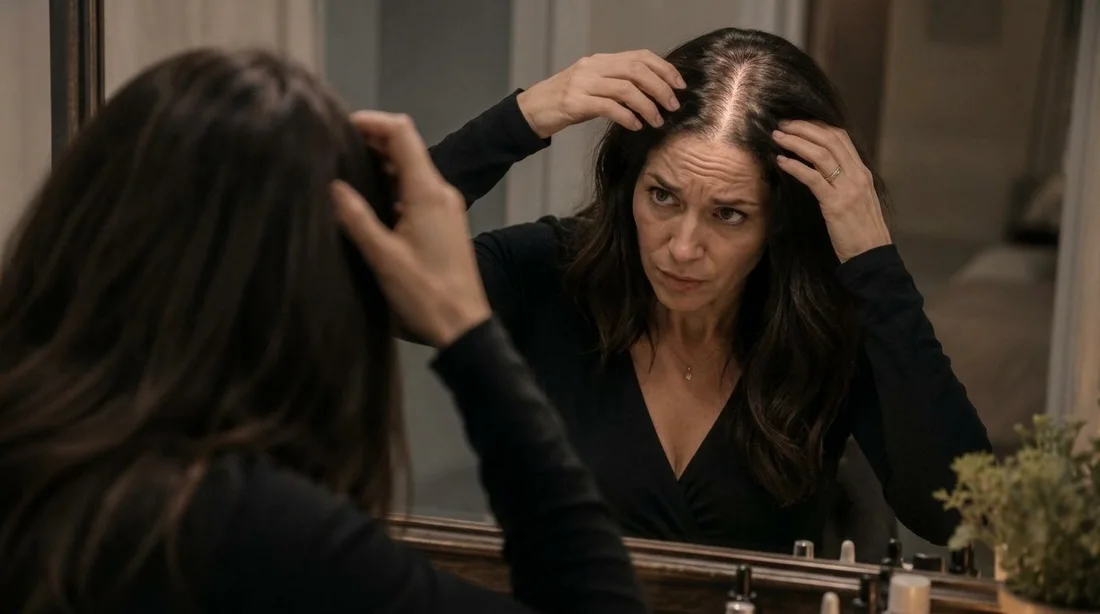

What's really happening under your scalp

For most of your life, estrogen helped keep your hair in its long growing phase. That's why many women have their thickest hair during pregnancy, when estrogen is high.
Around perimenopause and menopause, estrogen drops. Androgens like testosterone don't drop as much, so the balance shifts. In women who are genetically sensitive, follicles start reacting to DHT (dihydrotestosterone), a hormone made from testosterone. Over time, DHT makes follicles shrink, a process called miniaturization.
- The growing phase gets shorter.
- Each new hair comes in finer and weaker.
- The part widens and the crown thins, while the front hairline usually stays.

Here's the part almost no one tells you: a shrinking follicle is not a dead follicle. It's still there, still trying. That's why acting early matters so much, and why giving up is the worst thing you can do.
Is it menopause, or something else?
- Female pattern hair loss: gradual, a wider part and thinner crown, often with a family history.
- Telogen effluvium: sudden, all-over shedding 2 to 4 months after a stressor, illness, surgery or fast weight loss (including on GLP-1 medications; see our guide to GLP-1 hair loss).
- Thyroid problems or low iron: common, easy to check with a blood test, and very treatable.
Many women have more than one at the same time, which is another reason one single fix rarely feels like enough.
Why so many treatments feel like they don't work
- Expecting results in weeks. Hair grows about half an inch a month. Anything that works needs 3 to 6 months to show, and most women quit before that.
- Treating only the surface. Thickening shampoos, sprays and powders make hair look fuller for a day, but they don't change what's happening at the follicle.
- Running on empty. After 45, many women eat less protein and absorb fewer nutrients. A follicle that's already under pressure from hormones has an even harder time without the building blocks it needs.
- Stopping too soon. Whatever you choose, consistency is what turns "less shedding" into "a narrower part."
Menopause hair loss treatment: what actually helps
- Feed the follicle every day. Protein at every meal, plus biotin, zinc, vitamin C and B vitamins, the nutrients your hair uses to build keratin.
- Check iron, vitamin D and thyroid with a simple blood test. Fixing a deficiency can make a visible difference.
- Be gentle. Loose styles, less heat, no tight ponytails, a soft brush.
- Talk to a dermatologist about medical options for female pattern hair loss if your part keeps widening; there are proven treatments, and combining them with good nutrition gives your follicles the best chance.
- Protect your scalp from sunburn, which shows more as hair thins.
- Give it 3 to 6 months before you judge anything.
The usual fixes, compared honestly
Most women try these in roughly this order, and most feel like nothing worked. Here's why, side by side:
Make hair look fuller for a day.
The catch: they wash off. Nothing changes at the root.
One nutrient, often at a random dose.
The catch: it only helps if biotin was the one missing piece. Zinc, B vitamins and vitamin C matter too.
A proven drug for pattern hair loss.
The catch: you use it forever. Stop, and the shedding usually comes back. Scalp itching is common.
PRP, lasers, microneedling.
The catch: hundreds of dollars per session, and you need a series.
Biotin, zinc, horsetail and vitamins C, B3, B5, B6 together, every day.
Feeds the root from inside, for about $49 a month (the best-known brand charges $79–88). Our pick: Rosedil.
Natural, massaged into the scalp 2–3 times a week.
Matched 2% minoxidil in a 6-month trial. Our pick: WellaNaturals.
The real cost of "waiting to see if it stops"

Most women spend a year or two hoping it will settle down on its own. Here's what that year actually costs:
- $40 here, $60 there: another thickening shampoo, another spray, another serum that sits in the cabinet.
- Over 120 hours a year spent styling, covering and hiding, twenty minutes at a time.
- The photos you're not in, the invitations you turned down, the hats you wore when it wasn't even sunny.
- And the one that matters most: follicles that were still alive this year, and might not be next year. Thinning hair doesn't stand still. Every month you wait is a month harder to win back.
Doing nothing isn't free. It's the most expensive option there is, and you pay for it every morning in front of the mirror.
Inside or outside? Find out what YOUR hair actually needs
Here's the thing almost nobody explains: thinning hair has two very different starting points. Treat the wrong one and you can spend months "doing everything right" and see nothing. Treat the right one, and the change can start in weeks.
THE 60-SECOND HAIR CHECK
Tick everything you've noticed in the last few months
Why? See what each side means
Your follicles are starving
Every strand is built from nutrients your blood delivers to the root. When that supply drops, your body cuts hair first, because hair is the one thing it can live without.
You'll recognize it if:
- Hair is falling out all over, in the brush, the drain and on the pillow
- It started after weight loss, a diet, a GLP-1 medication, stress or illness
- Your hair feels thinner, drier and more brittle and grows slowly
- Your nails break easily too
What you need: to end the starvation at the root, because no shampoo or spray can feed a follicle from the outside. For these signs we point women to Rosedil: 4,620 mcg of biotin, zinc, horsetail and vitamins C, B3, B5 and B6, every nutrient your follicles use to build a strand, in two capsules a day. Buyers most often mention noticing it first exactly where it hurt most: fewer strands on the pillow, a cleaner drain, a brush you no longer clean as you go. And the price? The best-known dermatologist-recommended hair supplement costs $79 to $88 a month. Rosedil is $49 a month on the 6-month kit: six full months for less than four months of the famous brand, with a 60-day money-back guarantee.
Your follicles are being squeezed
Sometimes the nutrients are there, but the follicle itself is under attack: hormones (DHT) slowly shrink it, circulation in the scalp drops, and an irritated scalp makes it worse.
You'll recognize it if:
- Your part is getting wider or the crown looks see-through
- Your temples or hairline are thinning
- It came on gradually, with no clear trigger, or around menopause
- Your scalp is itchy, dry or flaky
What you need: to take the pressure off the follicle right where it lives, because a pill alone can't reach what's squeezing it. For these signs we point women to WellaNaturals Hair Oil: 40% rosemary oil, the natural ingredient that matched 2% minoxidil in a clinical trial, massaged into the scalp 2 to 3 times a week. No prescription, no "using it forever." The first thing buyers usually mention is a calmer, less itchy scalp; then, month by month, the part stops being the first thing they check under the bathroom light. Prefer something quicker and lighter? Emika Growth Spray puts caffeine and biotin on your scalp in two seconds a day.
Each one works on its own. Signs on one side? Start there. Signs on both? Start with the side where most of your signs are; adding the other later covers both causes at once. On a tight budget? Emika Growth Spray is the gentlest way to start, at about $18 a bottle. Every option has a money-back guarantee, and thinning hair never stands still, so the only real mistake is waiting another season. Want to compare everything side by side? See our full guide to the best products for thinning hair.
Three months from now, you'll be living one of two stories
In the first one, nothing changed. Another shampoo, another "it's probably stress." The part is a little wider than it is today, and you remember exactly what it looked like the day you read this.

In the second one, it's a Saturday morning, same bathroom, same terrible overhead light, and you're not measuring anything. You wash your hair with your eyes open. The brush comes out clean. You're out the door in ten minutes, hair down, in daylight, and the voice in your head that's been narrating your hair for years is finally quiet.
The only difference between those two stories is whether you start. And with a money-back guarantee, starting costs you nothing.
Keep reading: female pattern hair loss before menopause, hair loss on Ozempic and other GLP-1s and the best hair vitamins for thinning hair.

Audrey Larson
Audrey Larson is a health journalist and wellness investigator with more than 10 years of experience covering supplements, nutrition, and consumer health. With a background in Biomedical Science and Clinical Research, she specializes in analyzing scientific evidence behind health products and debunking misleading claims, misinformation, and fake health trends. As a Health & Wellness Evaluation Specialist for Olivewell Report, Audrey reviews peer-reviewed research, ingredient transparency, and manufacturing standards to separate fact from fiction. Her work emphasizes scientific integrity and practical guidance, helping readers make informed decisions about their health and well-being.
Keep reading
Skin, Hair & NailsCastor Oil for Hair Growth: How to Use It, How Long It Takes, and the Blend That Makes It Easier
Grandma swore by it, and now it's all over social media: a few drops of castor oil on the scalp for thicker, longer hair. Here's exactly how to use castor oil for hair growth, why so many women give up on it, and the blend that makes it easy.
 Skin, Hair & Nails
Rosemary Oil for Hair Growth: Does It Really Work? (The Study, How to Use It and Before & After)
It's the most searched natural hair remedy in America, and unlike most viral trends, this one has a real clinical trial behind it. Here's what rosemary oil actually does for thinning hair, how to use it so it works, and the mistake that makes most people quit too early.
 Skin, Hair & Nails
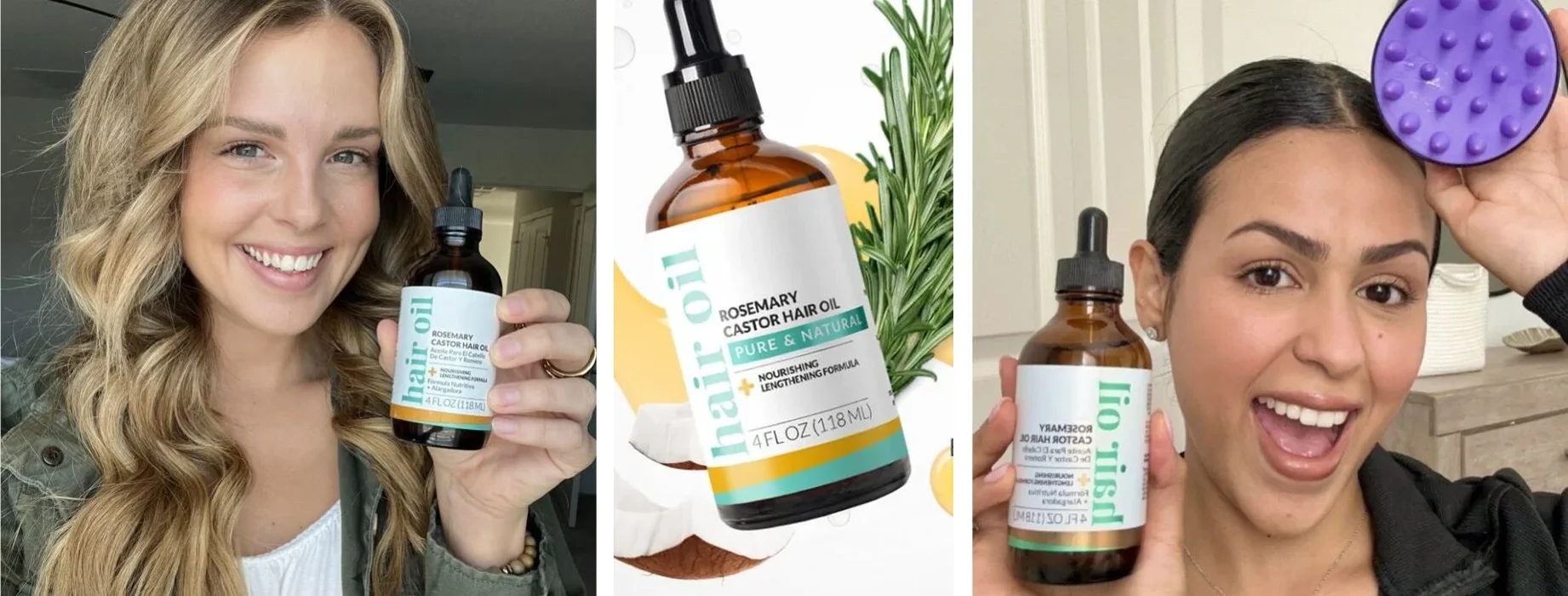
Best Hair Growth Oil (2026): Rosemary, Castor and What Actually Works for Thinning Hair
Rosemary, castor, coconut, pumpkin seed: every oil promises thicker hair. Only a few have real research behind them. Here's which hair growth oils actually work, how to use them, and the one we'd buy.